

LEVEL 1.4
WHAT IS IN THE BIBLE OR NEW TESTAMENT
DIFFERENCE BETWEEN THE OLD & NEW TESTAMENT 1/5
The Old covenant contains 39 books.
Some bibles have the old and new testament together, where the old testament is the original Covenant for the Jewish nation, who were singled out to represent God and his commandments for mankind, and the Jews were to evangelize the surrounding nations as a people of God; which task they ultimately failed to carry out and became like the heathen nations around them, as we see in the books of the prophets such as Jeremiah, Elijah and Isaiah.
The New Covenant –It contains 27 books
We will only focus on the new Covenant, where Jesus came to earth as the Messiah in fulfillment of Jewish prophecy, and according to Paul, cancelled the old covenant and established a new covenant. It was written and signed by the sacrificial blood of Jesus as he died on the cross, thus beginning a new era for all mankind; the subsequent events recorded in the various books of the New Testament by witnesses show us what happened and what this really means.
A covenant is a contract, much like a marriage, with certain costs and conditions, benefits for parties involved.
What is the bible all about?
The bible in a sense, is a history of mans troubles, and a loving Creator God guiding their destiny, bringing messages of hope, salvation, healing and deliverance among others benefits. We will look more closely in the coming modules as to what these writings contain and how they affect us as believers in a practical sense.
The New Testament comprises 27 books
A number of years ago, when I was compiling all my many notes on bible topics, relative contexts and principles among others, I was confused, as I needed to make some sense and compile an orderly analysis of what the New Testament was all about. Taking it to the Lord in prayer, I had a dream one morning, where the areas and relevant teachings etc were laid out in 4 C’s- this lead to my compiling this course in the manner in which I have done.
Areas of the life of Christ were clearly defined in terms of the content of the New Covenant.
Quite simply, it was revealed that there were 3 areas of concern regarding Jesus Christ as follows-
- Christ– This is self evident
- Church– This is self evident
- Christian– The believer’s role
- 4. Covenant God and His contract with mankind
God’s will for mankind is contained in the contract or New Covenant. His benefits and the requirements for us to have peace on Earth and eventually join Him in heaven are what is contained in the bible, in both the Old and the New Testament.
THE CENTRAL TOPICS IN EACH OF THE BOOKS 2/5
The next thing I needed to know was what the original purpose of each of the 27 books recorded in the bible was, so that led me to analyse and sift through every one for months, in other words, what was the main topic the writer wanted to convey. This was apart from all the other peripheral information, exhortation and teachings- the result was that I found 9 topics in each of the 3 areas, which gave a logical background and summed up the whole covenant.
9 Writers
Looking at the various writers, I found a total of 9 writers, if one assumes that the book of Hebrews was written by Barnabus (some suggest Paul was the writer; for the purpose of this discussion it is largely irrelevant)- I will list them in the next module which seemed an interesting discovery, when I put it all together. Of course many will differ about my findings and analysis, as always, but for me it was a simple way of understanding the main themes of each of the books. By adjusting the individual writers, against the topics in an orderly fashion, I was able to set up a chart that shows the following-
27 Books, Covering 3 Main Areas, With 9 Topics and 9 Writers
We must remember- it is all about Jesus that is the prime factor in all books of the New Covenant.
Understanding and wisdom is required when we read the bible
In the next section, we will look at how to read and study the bible correctly, as there are many opinions, viewpoints, perceptions which are more often than not taken or quoted completely or partially out of context. More often than not we will see hearsay and or heresy, which is truth mixed with fiction, often saying the bible says so, without being able in any way to prove or quote where to find it.
What were the writers wanting to say that was urgent?
It is vital that before commencing to study the word, that certain ideas and methods are clarified, so as to more accurately understand what the writer is saying-this is the essence of any study, to avoid any incorrect interpretation. In the next section we will look at how to do a bible study in orderly and logical fashion, in order to avoid ending up in meaningless arguments and debate, as Paul often says to Timothy, that he should avoid arguments, which are really illogical discussions, without experiential knowledge.
The 27 books written by 9 authors
The following is a list, or table of these findings; also there were arguably 9 writers, and the one possible discrepancy would be the writer of the book of Hebrews, which for the purpose of this discussion, we will allocate to Barnabus, who was related to John Mark.
There were 3 themes throughout relating to God’s Covenant
Description of contents and themes or central topics of each book laid out in the following table, which took many months of intense bible study and analysis. This is a possible summary of each of the 27 books in the New Testament, described by its intent, content and purpose.
What are the main themes in each book?
The objective is to examine the main purpose behind each book that the writer had in mind, in a single word.
The categories are broad and obviously contain other material, but in essence it is all about-
Jesus the Christ, His church and the Christian believers who follow Him.
The word of God- biblical knowledge about the life of Jesus is important; however it is also more important to know –
The God of the word.
It is vital for us to know everything about Jesus and His teachings, His commands, What He did, why and how He did things; also what he requires of us- this is all set out within the New Testament
This summary is from a divine revelation, laid out in an orderly manner, and should sum up the full content of Jesus’ ministry, His church and the Christian believer.
THE STRUCTURE/THEMES OF THE NEW TESTAMENT 3/5
The following table shows books written and their main theme
- NB. The main purpose is to show the topics or themes together under each
The books are NOT in the order laid out in the Bible.
THE STRUCTURE / THEMES OF THE NEW TESTAMENT 3/5
|
|
Writers |
|
Christ |
|
Christian |
|
Church |
|
1 |
Mathew gospel |
1 |
Teachings |
|
|
|
|
|
2 |
Mark gospel |
2 |
Work |
|
|
|
|
|
3 |
Luke gospel |
3 |
Concern |
|
|
|
|
|
|
Acts |
4 |
Witness |
|
|
|
|
|
4 |
Barnabus? Hebrews |
5 |
Exalted |
|
|
|
|
|
5 |
John gospel |
6 |
Belief |
|
|
|
|
|
|
Revelation |
7 |
God triumphant |
|
|
|
|
|
|
1 John. 1 |
|
|
1 |
Fellowship tests |
|
|
|
|
1 John. 2 |
|
|
2 |
Walking in truth |
|
|
|
|
1 John. 3 |
|
|
3 |
Living in truth |
|
|
|
6 |
James |
|
|
4 |
Living in faith |
|
|
|
7 |
Paul Romans |
|
|
5 |
Living right |
|
|
|
|
1 Thessalonians |
|
|
6 |
Living examples |
|
|
|
|
Titus |
|
|
7 |
Living lifestyle |
|
|
|
|
Galatians |
|
|
8 |
Living no law |
|
|
|
|
Philemon |
|
|
9 |
Living in love |
|
|
|
|
2 Thessalonians |
8 |
2nd Coming |
|
|
|
|
|
|
Colossians |
9 |
Personified |
|
|
|
MINISTRY |
|
|
1 Corinthians |
|
|
|
|
1 |
problems |
|
|
2 Corinthians |
|
|
|
|
2 |
guidelines |
|
|
Ephesians |
|
|
|
|
3 |
relations |
|
|
Philippians |
|
|
|
|
4 |
loyalty |
|
|
1 Timothy |
|
|
|
|
5 |
behaviour |
|
|
2 Timothy |
|
|
|
|
6 |
guidelines |
|
8 |
Peter Book 1 |
|
|
|
|
7 |
conduct |
|
|
Peter Book 2 |
|
|
|
|
8 |
growth |
|
9 |
Jude |
|
|
|
|
9 |
false teachers |
|
9 |
Tot writers |
9 |
Tot -Christ |
9 |
Tot -Christian |
9 |
Tot- Church |
Conclusion
The main thing about the above table is that we can more clearly see what God laid out on the hearts of His chosen or called ones, and that the bible or the New Covenant clearly spells out what God desires of us as follows-
Christ-We need to know all about Him, who He is and why He came.
Church-We need to know that Jesus came to establish His Church to destroy the works of satan.
Christian-We need to know God’s love and how to love ourselves and our neighbour.
Covenant-We need to know what the contract between God and ourselves means.
HOW TO STUDY THE BIBLE EFFECTIVELY 4/5
A thought to ponder on-
An often quoted statement goes like this- the word of God above all things- which is admirable, I’m sure, but is that all there is to it? Many are the churches and believers who may well get to know the word of God very well, and yet do not know the God of the word-or word of God.
For the purpose of this particular module, we will confine our attention to the following.
Which bible is best?
To answer this question, a study of church History will reveal that the NIV and King James are very close, where we will see a comparison of many bibles from the 14th Century; the most accurate are the NIV revised and the new King James revised. Many other translations are rendered more easier to read, and in so doing lose the spiritual context.
Get a study bible from the start- and focus on the New Testament.
It is a bit more expensive, but having extensive notes to explain each verse. This will maximise your study time more effectively.
A disciplined approach is required when studying any subject; the same is true of the bible.
A logical approach is to start from the first page, as this is a sure way to avoid disaster and lack of understanding.
Read from Cover to cover-
Don’t play Bible roulette and just read where it happens to open.
When studying any subject always start from page 1 and work your way through the book.
Begin from the first book, which is Mathew, and all the gospels till the end.
We need a thorough Knowledge of Jesus life and ministry.
This is vital to avoid falling into confusion and heresy.
When beginning the study-
Pray that Holy Spirit will enlighten your understanding.Eph.3.16-20
Have pen, ruler and highlighter available, in a quiet room.
Set a target of at least 2 pages per day
Read your bible every morning before, or at breakfast time.
This will enable you to find it later when you look for it.
Bible study cont.
Keep a note pad, or journal handy
Make notes and jot down anything that comes to mind.
As an example your favourite scriptures, questions etc.
Highlight, or underline, a scripture that stands out.
This will help in the future so you can find it again; possibly different colours for different topics
As a suggestion we can do as follows-
Chapter headings- Orange
Miracles or spiritual occurrences- Blue
Teachings – Red
Practical information to use- Green
Electronic Bibles on Cell phones
They have a built in facility to highlight verses in colour.
Square off any section you wish to find easily next time.
This will really make a favourite verse etc standout, and make it easily able to be found again.
Use the back of the bible for scripture verses and notes if necessary, and or a note book.
Memorising scripture
This is important, because there will come a time in the future when you will need it so as to encourage someone, and give them a scripture relevant to their situation at that time.
Praying for others
When praying for someone it is also helpful to be able to remember a particular verse-
If you can, try and remember chapter and verse. When Jesus was confronted by the devil in the desert, all he did was to quote scripture, and in the right context.
Books debated in the New Testament 5/5
The New Testament as we know it was compiled around 300 A.D.
This compilation took place after discussions between the Eastern Orthodox Church and the Western Pentecostal groups. Because of the time lapse of almost 300 years, many manuscripts and writings were largely ignored because of doubts about their authenticity.
The Bible we have today therefore was well researched and although a number of books were excluded, this does not mean that they are not authentic. It is just that its origin could not be proved.
Below is an idea of what took place, and which books debated by the council were accepted eventually.
BOOKS ACCEPTED WESTERN EASTERN ORTHODOX
Johns Epistles 1&2 Accepted Genuine
James Questioned Genuine
Jude Questioned Genuine
Hebrews Questioned Genuine
2 Peter Questioned Genuine
Revelation Questioned Genuine
BOOKS NOT AGREED UPON INCLUSION INTO THE BIBLE
Peters revelation Questioned Unsure
Didache Uncertain Genuine
Shepherd of Hermas Questioned Unsure
OTHER BOOKS OF FIRST CENTURY CHRISTIANS
Note-There were many Christian saints, Bishops, archbishops etc who were inspired by God.
Those who came after the era of the first disciples were many and I will name a few men who have gone down in history as saints and martyrs of the church. It was only around the 16th Century when printing of books began that these stories of historical events were uncovered.
Names such as Polycarp from Smyrna or Izmir as it is known today was rumoured to be the young child who sat on Jesus’ knee and became a well loved citizen of that town.
I have personally been in the church of Polycarp in Smyrna and seen his amazing story as follows.
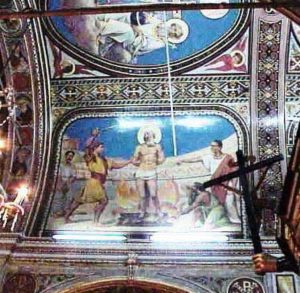
Polycarp-
They tried to burn him at the stake-but the fire could not burn him!
At 85 years of age he was taken by the Romans to be burned at the stake. They wanted to tie him but he declined. The fire was started but he stood in the middle praising God, and was gazing serenely heavenward with not a burn anywhere, as it seemed a bubble had formed around him. They increased the fire, and like the story of the 3 men in the fire in the Old Testament, he was not harmed. Eventually after a long time, a soldier ran forward and stabbed a spear into his side through the bubble and then he died, seemingly without any pain. Others such as Clement, Ignatius, Justin martyr and the historian of the second century Eusebius, who recorded much of early Christian history..
First century writings of the second generation of Christian apostles a
Clement Letter to the Corinthians
Ignatius Letters to the Ephesians, Romans, Smyrna, Magnesians, Trallians, Polycarp
Polycarp Letters to the Philippians, Diognetius
Barnabas Epistle
Didache The teachings of the Apostles, recorded by Eusebius.
Summary- How to study the Bible
Things to do
- Reading program-at least 2 pages a day; if kept up, this will complete the NT in 3 months.
- A yearly goal –from front to back page, try and read the NT 2-3 times per year
- You will find that the more times you have read the new testament, that your understanding will increase, esp. as you will be in different seasons of your life, and other areas and topics will become more relevant.
- Revelation will begin to flow, and deeper spiritual insights become apparent as one matures in Christ- I personally have now studied the New Testament from front to back app. 3 times every year since 1988 at the time of writing, and have gone through many seasons, with constantly new and fresh revelations opening up before me.
- The bible will become alive to your spirit, as you delve into its mysteries.
- Times of study-mornings- the New Testament; evenings, the Old testament- as a suggestion.
- Type of bible-very important to get a study bible, such as the New International Version etc.
- When you don’t understand a verse, look at the notes below, this will greatly assist progress.
- Put a start date when you began to read the bible; and a finish date when completed in the back; this will be a type of history record to show how you progressed over the years.
- A spiritual diary-to keep track of answered prayers, spiritual experiences, revelations etc.
- Reading methods-initially-
Skimming– like a sea gull across the water just looking to see the lie of the land; then Scanning– this is more detailed, reading it seriously.
Meditating or studying- where it is examined, notes are made, meditating on the content, Contemplating a response from ourselves-this will ensure a sound knowledge of God’s word.
Things to remember
- This is a brief overview of the compilation of the New Testament from historians and others
- There will always be controversy around historical events.
- The New Testament is no exception, and was only put together around the 3rd century.
- There is one certainty to bear in mind, in the face of uncertainty- and that is that Jesus appeared on this earth more than 2000 yrs ago; there even appear to be some contradictions between the gospels, and the following examples will help answer these difficulties.
- Whenever and where ever Jesus walked and taught, it was not possible for all the disciples to be with Him at the same place in very close proximity at every meeting-this will cause each disciple to have slightly different viewpoints of the same event, that is taking place.
- An example is the woman with the issue of blood who touched Jesus; when He asked who touched Him, the disciples were incredulous, because they did not see what happened, as the crowds were all around Him.
- Another time Jesus was on a mountain with his close disciples, Peter, John and James-the others were at the foot of the mountain, so it is obvious that they could not know about, or be able to write about Moses and Elijah appearing before Jesus. Only the 3 disciples present could make any accurate statements; the others, if they chose to write about that particular event, would be second hand as related to them by the three.A last example is in the book of Mark where he writes about a young man running away naked when Jesus is arrested.
Studying the Bible cont.
- No one else mentions that event because it had to be Mark himself, For him it was important to describe that particular event in the book that he wrote (Mark was the one that Peter referred to as my son, at the end of the second book of Peter. He was the son of Mary, who stayed in Jerusalem, and where the disciples often gathered.)
- This is why certain events will be described differently, depending on who was where, at a particular point in time, in each gospel.
- Finally-remember that this is a new contract between God and mankind, brought down from Heaven by Jesus by His Father, and written and sealed by His blood on the Cross.
- It is of utmost importance that we understand not only the benefits for us, such as being able to enter heaven with all the perks, but equally important that we understand the terms of the contract !
Questions to ask yourself
- Do you read the bible on a regular basis?
- Do you enjoy what you read?
- Is the bible still a dull book, or has it become alive to you?
- Does it strike you as God speaking to mankind?
- Further, do you see it as a manual for living, with Jesus as the ultimate role model?
- Have you started to memorise any verses that are meaningful to you?
- Do you pray for others, and use scripture?
Discussion Questions
Getting started
Read Level 1.4 and the summary
Read also how and when it was finally put together
Read the following verses and discuss the questions
WHAT IS A TESTAMENT, AND A COVENANT
We are all familiar with a will, which is drawn up for when somebody dies,; this is a type of contract that is legally drawn up and must be registered by law to have any effect
Explain in your own words what a testament means
Explain in your own words what a covenant means
The Old Covenant
The Old Covenant, or testament, was given to Moses in order to guide the Israelites, and to understand that there was a God who cared for them; in order for this to take place, there were various requirements needed for the people to carry out
Lk. 1.72 To remember His Holy Covenant; what was that
Ge. 6:18 But I will establish my covenant with you, and you will enter the ark—you and your sons and your wife and your sons’ wives with you; why does God need to establish a covenant, and what does he mean
Ge. 9:13 I have set my rainbow in the clouds, and it will be the sign of the covenant between me and the earth; how does God sign His covenant
Ex. 24:8 Moses then took the blood, sprinkled it on the people and said, “This is the blood of the covenant that the LORD has made with you in accordance with all these words.; what has blood got to do with a covenant
Ex. 34:28 Moses was there with the LORD forty days and forty nights without eating bread or drinking water. And he wrote on the tablets the words of the covenant—the Ten Commandments; what is the old covenant all about
Jer. 31:31 “The time is coming,” declares the LORD, “when I will make a new covenant with the house of Israel and with the house of Judah.v:32 It will not be like the covenant I made with their forefathers when I took them by the hand to lead them out of Egypt; What was the old prophet Jeremiah talking about
The New Covenant
Jesus came to cancel the old covenant, and establish a ‘new’ one; this was necessary because the people of Israel were unable to keep to the old one; this was according to the plan of God who ‘sent’ Jesus to earth to carry out His will, and demonstrate the kingdom of God on earth
Mt. 26:28 This is my blood of the covenant, which is poured out for many for the forgiveness of sins; what covenant is Jesus talking about
Jn. 14.26 But the Counselor, …will teach you all things and will remind you of everything I have said to you; why is it necessary to be reminded of what Jesus said and taught
Jn. 15.7 If you remain in me and my words remain in you, ask whatever you wish, and it will be given you; here again Jesus talks about His words; how important is it to remember what He said,
Jn. 8.31 To the Jews who had believed him, Jesus said, “If you hold to my teaching, you are really my disciples; how important should it be then, to study His word and read the New Testament
Mt. 7:24 “Therefore everyone who hears these words of mine and puts them into practice is like a wise man who built his house on the rock; what are the benefits of obeying Jesus teachings
Lu. 9:26 If anyone is ashamed of me and my words, the Son of Man will be ashamed of him when he comes in his glory and in the glory of the Father and of the holy angels; Does this mean we should be able to quote Jesus teachings and words to others, and when should we do this
Hope you enjoyed this little test-well done if you answered all!!